

Why You Should Never Use a Regular Vacuum for Liquid Spills
You should never use a regular vacuum for liquid spills – it sounds obvious when you say it out loud, but in real-world situations people still do it. A glass tips over, your washing machine overflows, someone tracks in rainwater across the floor, and the nearest vacuum is right there. You plug it in, thinking you’ll deal with it quickly.
That’s usually where the trouble starts.
The core issue: water and motors don’t mix
A standard dry vacuum cleaner is built around airflow, dust filtration, and insulation designed specifically for dry debris. Inside, you’ve got an electric motor pulling air through filters and into a dust chamber. Those filters are not designed for moisture, in fact, they actively resist it.
When liquid enters that system, a few things happen almost immediately:
- Moisture bypasses or saturates filters
- Airflow becomes unstable
- Water reaches internal electrical components
- Heat builds up unevenly
In many cases, the motor doesn’t “instantly explode” like people imagine. It’s usually more subtle like you might hear a change in pitch, maybe a slight burning smell. Then it stops working or it keeps running but with internal damage that impacts the cleaning efficiency. That’s because once water compromises insulation around the motor windings, failure is only a matter of time, sometimes minutes, sometimes a few uses later.
Short-term vs long-term damage
A lot of users assume, “I only did it once, it’s fine.” That’s not always true. Even if the vacuum keeps running after picking up liquid, you might have:
- Corrosion beginning inside the motor housing
- Mold growth in damp filters or chambers
- Reduced suction from clogged airflow pathways
- Electrical risk if moisture lingers
In humid environments, like coastal regions or monsoon-prone areas, this gets worse. Moisture doesn’t evaporate cleanly, instead it stays trapped, and over time you end up with a machine that smells off and performs poorly.
You’ll notice it gradually, suction drops, noise changes and it just doesn’t feel right anymore.
Why manufacturers warn against it
If you check most vacuum manuals, they explicitly say not to use the unit for liquids unless specified. This isn’t just legal protection, but a design limitation.
Dry vacuums rely on:
- Paper or fabric filters
- Open motor airflow systems
- Dust-only containment
Liquids disrupt all three. In contrast, wet and dry vacuums are built with sealed motor housings, float valves, and separate filtration systems that handle both air and water safely. It’s a completely different engineering approach that is designed to handle wet spills with ease.
What a wet & dry vacuum does differently
A proper wet and dry unit separates liquid handling from electrical components. It’s designed to deal with unpredictable conditions.
Key differences include:
- Sealed motor housing to prevent water ingress
- Float valve system that shuts off suction when the tank is full
- Non-porous tanks for easy drainage and cleaning
- Dual filtration options depending on wet or dry mode
These aren’t optional extras, they’re essential if you’re dealing with mixed debris or emergency spills.
A practical example: Pullman CB15-SS Wet & Dry Canister
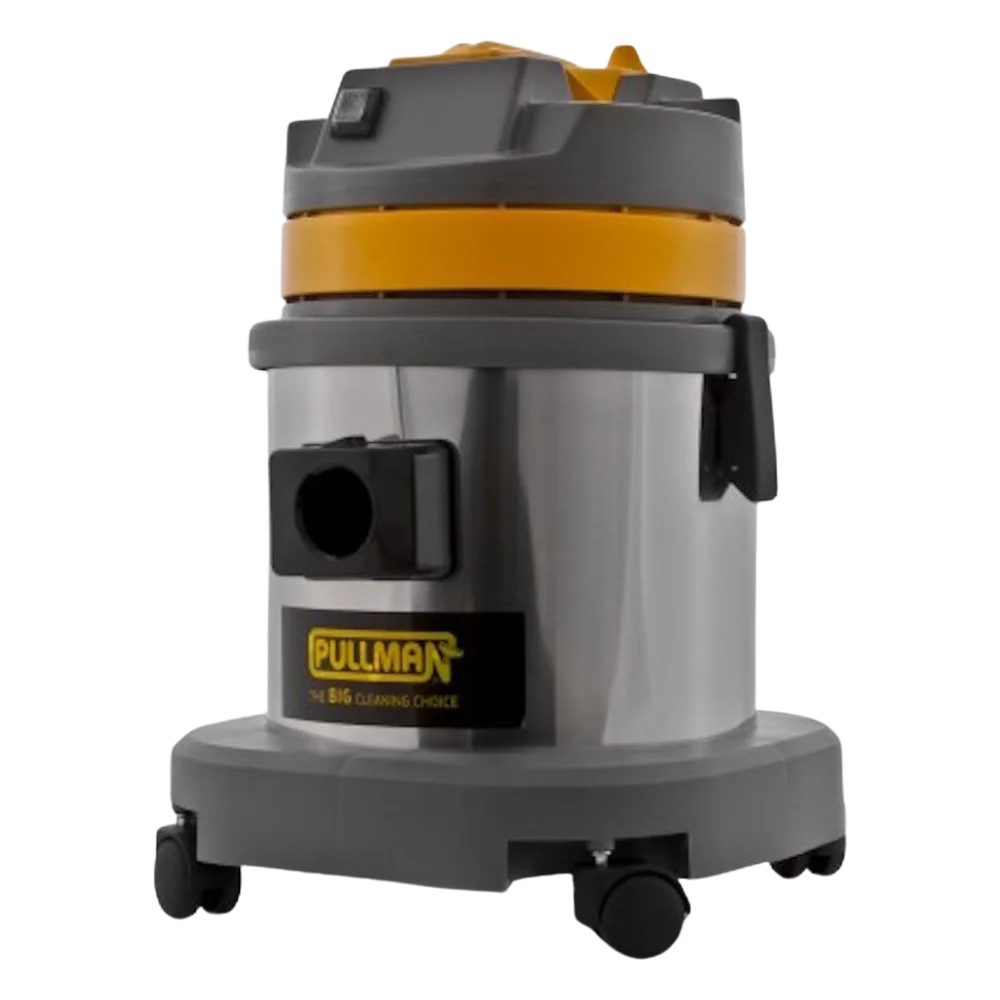
The Pullman CB15-SSc Wet & Dry Canister is a good reference point for what a proper unit should look like in a professional or semi-industrial setting.
You’ll notice right away it’s not built like a household vacuum.
- 15-litre stainless steel tank: This matters more than people think. Stainless steel resists corrosion, especially if you’re picking up water with detergents or mild chemicals. Plastic tanks can degrade over time depending on usage.
- Robust motor design: It’s engineered to handle both wet and dry applications without overheating under load. In practice, that means you can switch between cleaning sawdust and water spills without worrying about internal damage.
- Float shut-off system: Once the tank fills to capacity, suction is automatically cut. This prevents overfilling and stops liquid from reaching the motor. It’s a simple mechanism, but critical to the longevity of your vacuum.
- Versatile attachments: You’re not just dealing with flat surfaces, you might regularly clean corners, upholstery and vehicle interiors and here the attachments come handy.
- Mobility and stability: In a garage or workshop, you’re moving around tools, cables, uneven flooring. A stable base with smooth movement actually saves time and reduces frustration.
Why every garage or laundry should have one
It’s not about over-preparing but about recognising how often liquid-related messes actually occur. In most households or workspaces:
- Washing machines fail occasionally
- Pipes leak
- Vehicles bring in water and mud
- Cleaning jobs involve both wet and dry waste
A dedicated wet and dry vacuum isn’t used every day for liquids, but when you need it, nothing else substitutes properly. Trying to improvise with a dry vacuum usually ends up costing more. Either you damage the machine or you don’t clean the spill effectively, leading to further issues like odors or material damage.
Cost vs consequence
People hesitate because a wet and dry vacuum feels like an extra purchase. But it can feel like a value addition if you consider:
- Replacing a damaged dry vacuum
- Repair costs for motor failure
- Potential electrical hazards
- Time lost dealing with ineffective cleanup
In trade environments, downtime matters. In homes, it’s more about convenience and avoiding secondary damage like warped flooring or mold. Either way, the math tends to favour having the right tool.
Final thoughts
Using a regular vacuum for liquid spills is one of those shortcuts that rarely pays off. It might seem harmless in the moment, especially if the spill is small, but the internal damage isn’t always visible right away. If you’ve ever noticed a vacuum losing power or smelling odd after a “one-time” wet cleanup, that’s usually the reason.
A dedicated wet and dry unit, something along the lines of the Pullman CB15-SS, isn’t just for professionals. It’s a practical piece of equipment for anyone dealing with real-world messes, where things don’t stay neatly dry. And in most cases, it’s better to have it sitting there unused than to need it and not have it.
So, if you wish to add a wet and dry unit to your cleaning collection, shop with us at About Clean. With us, you can shop for all premium models at industry-leading prices.